

Pet Dander and Duct Cleaning in Ontario: Does It Help?

By Ontario Duct Cleaning · Last reviewed November 2026
Short answer: Duct cleaning can remove the pet hair and dander that build up in your ducts, but it isn’t a cure for pet allergies. Studies haven’t shown it relieves symptoms on its own. It works best alongside a higher-rated furnace filter, HEPA vacuuming and keeping pets out of bedrooms.
Pets are part of more than half of Canadian households, with about 7.2 million dogs and 8.2 million cats, according to the 2024 Canadian Pet Population Survey. If you share your home with one, you’ve probably wondered whether the hair and dander ends up in your ducts, and whether cleaning them helps with allergies. Here is what duct cleaning can and can’t do for pet owners.
What is pet dander?
Pet dander is made up of tiny flakes of skin shed by cats and dogs. The proteins in it, and in an animal’s saliva and urine, are what trigger allergies. Dander is light enough to travel through the air, so it settles in bedding, carpets, upholstery and, over time, your ductwork. According to the American Lung Association, up to 30% of people with asthma are also allergic to cats or dogs.
Can pet hair and dander build up in your ducts?
Yes. Hair, dander and dust can collect inside ducts, especially in homes with heavy-shedding pets. A 2010 Canadian research review found that ducts can hold dust and act as a reservoir for microbes. It also found no field studies linking dirty ducts directly to poor indoor air. So buildup is real, but it’s one piece of the picture.
What duct cleaning can and can’t do
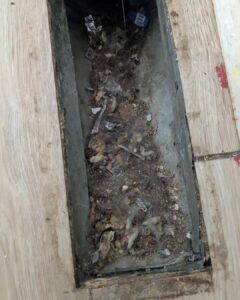
What it can do: remove built-up hair, dander and debris from your ducts, including what your filter missed. For pet owners, that is pet dander removal from the ducts themselves. At Ontario Duct Cleaning, we take the time to clean the whole duct system fully. The dirtier the system, the more time the technician needs for a complete cleaning.
What it can’t do: cure allergies on its own. The US EPA says duct cleaning has never been shown to prevent health problems, and Canadian housing studies found it usually doesn’t change the air you breathe. The EPA also doesn’t recommend routine cleaning. It suggests cleaning when ducts have visible mould, vermin, or a heavy buildup of dust and debris. For pet owners, visible hair and dust at the vents is a reasonable sign to book.
The honest approach is to treat duct cleaning as one part of a plan, not the whole plan.
Where pet dander collects, and what helps
| Where it collects | What helps |
|---|---|
| Bedding and mattresses | Keep pets out of bedrooms |
| Carpets and upholstery | Vacuum with a HEPA-filter vacuum |
| The air in your home | Run a HEPA air cleaner (see our air purifier advice) |
| Your furnace filter | Use a higher-rated filter, such as MERV 13 if your furnace can handle it |
| Your ducts | Professional duct cleaning removes built-up hair and debris |
| Humidity (dust mites feed on dander) | Keep indoor humidity below 50% |
How often should pet owners clean their ducts?
Ontario Duct Cleaning recommends cleaning your ducts every 3 to 5 years. If you have pets, or anyone in the home has allergies or asthma, aim for every 3 years. For the general answer, see how often to clean your ducts.
Does your furnace filter catch pet dander?
It depends on the filter. Basic fiberglass filters (MERV 1 to 4) catch less than 20% of larger dust particles, according to the US EPA. A higher-rated filter, such as MERV 13 if your furnace can handle it, traps far more of the small particles that carry pet allergens. Check your furnace manual or ask a technician before upgrading, because a denser filter can restrict airflow.
What about dust mites?
Pet dander is food for dust mites, but mites live mostly in bedding, carpets and furniture, and they need humid air to survive. Dust and debris that collect in ducts can hold microbes, which is one reason to keep ducts clean, alongside controlling humidity.
When to book
- You can see pet hair or dust building up at your vents or return grilles
- You haven’t had your ducts cleaned in a long time and you have heavy-shedding pets
- Someone in the home has pet allergies and you’ve already tried the steps in the table above
Find your local Ontario Duct Cleaning office
- Halton: Mississauga, Hamilton, Oakville, Brampton, Burlington, Etobicoke, Orangeville
- Toronto: Toronto, Scarborough, North York
- York Region: Newmarket, Markham, Richmond Hill, Barrie
- Durham Region: Oshawa, Whitby, Ajax, Pickering, Peterborough, Lindsay, Uxbridge
- Kitchener-Waterloo: Kitchener, Waterloo, Cambridge, Guelph, Brantford, Stratford
- Belleville-Hastings: Belleville, Kingston, Cobourg
- Niagara: Niagara Falls, St. Catharines, Welland, Fort Erie, Grimsby
- Middlesex-Oxford: London, Woodstock, Tillsonburg, Simcoe, St. Thomas
- Windsor-Chatham-Sarnia: Windsor, Chatham, Sarnia
Frequently asked questions
Does duct cleaning help with pet allergies?
It can help as part of a plan, but it isn’t a cure. Cleaning removes the hair and dander that have built up in your ducts. Research hasn’t shown that duct cleaning on its own relieves allergy symptoms, so pair it with a higher-rated filter, HEPA vacuuming and keeping pets out of bedrooms.
How often should I clean my ducts if I have pets?
Ontario Duct Cleaning recommends every 3 to 5 years, and every 3 years if you have pets or anyone in the home has allergies or asthma. Visible hair at your vents is a good sign to book.
What is pet dander and where does it settle in a home?
Pet dander is made up of tiny flakes of skin shed by cats and dogs. The proteins in it are what trigger allergies. It’s light enough to travel through the air, so it settles in bedding, carpets, upholstery and ductwork.
Do furnace filters catch pet dander?
Basic fiberglass filters (MERV 1 to 4) catch less than 20% of larger dust particles, according to the US EPA. A higher-rated filter, such as MERV 13 if your furnace can handle it, traps far more of the small particles that carry pet allergens. Check your furnace manual or ask a technician before upgrading.
Can pet hair and dander build up in air ducts?
Yes. Hair, dander and dust can collect inside ducts, especially in homes with heavy-shedding pets. Ducts can also hold microbes alongside that debris, which is one reason to keep them clean and humidity under control. Research hasn’t directly linked dirty ducts to poor indoor air, though.
What else should I do besides duct cleaning if someone in my home is allergic to pets?
Keep pets out of bedrooms, vacuum with a HEPA-filter vacuum, run a HEPA air cleaner, wash up after handling pets, and keep indoor humidity below 50% to limit dust mites. Add a higher-rated furnace filter, and duct cleaning when buildup is visible.
Have pets and want your ducts checked? Find your local Ontario Duct Cleaning office.
Sources:
- Canadian Animal Health Institute, 2024 Canadian Pet Population Survey
- US EPA, What is a MERV rating
- US EPA, Should you have the air ducts in your home cleaned
- American Lung Association, Pet dander
- American Lung Association, Dust mites
- Sultan, Indoor Air 2010 (NRC review of duct cleaning evidence)
- National Defence housing handbook, Air quality (summarizes CMHC studies)
